Mental healthcare is digitizing at a rapid pace. Psychologists and other practitioners have long ceased using the electronic patient record (EPR) exclusively behind a fixed computer in the office. Smartphones and tablets are increasingly being used for documentation, client communication, monitoring, and parts of the treatment. This development aligns with hybrid and network-based care, but also touches upon a deeper underlying problem in mental healthcare: the structural imbalance between providing care and accounting for it.
Various studies show that mental health care-professionals spend well over a third of their working time on administration and reportingAt the same time, organizations are struggling with staff shortages, high turnover, and long waiting times. Every minute not spent on treatment counts. Digitization must therefore not only be smarter, but above all be applied more efficiently and professionally.
The question is therefore not whether mobile working makes sense, but when it truly contributes to less administrative burden and more time for the clientAnd when the fixed workplace remains indispensable.
The power of mobile working for practitioners
For psychologists and outpatient practitioners, mobile working can offer concrete benefits. During home visits, intakes, or guided exercises, relevant information can be recorded immediately: observations, client statements, and progress indicators. This reduces the risk of duplication of work afterwards and lessens the mental burden of “remembering to record later.”
Moreover, mobile devices align well with blended careThink about reviewing questionnaires together, using visual psychology-education or discussing monitoring data such as mood, sleep, or stress measurements. When such data are available digitally in advance, the conversation can focus on interpretation and meaning rather than inventory.
The discussion on mobile working cannot be viewed in isolation from the administrative reality. When professionals already spend 30–40% or sometimes even more of their time on registration, any technological innovation must contribute to reduction of administrative burden, not to relocation or concealment thereof. Mobile working that leads to duplicate recording, extra notifications, or increased availability actually increases the pressure.
The use of a smartphone or tablet in the presence of the client This requires professional awareness. Clients may perceive this use as a distraction or a sense of distance. Transparency is therefore crucial: explicitly stating why a device is being used and using it together whenever possible helps to strengthen the therapeutic relationship rather than disrupt it.
Prerequisites and risks: more than just security
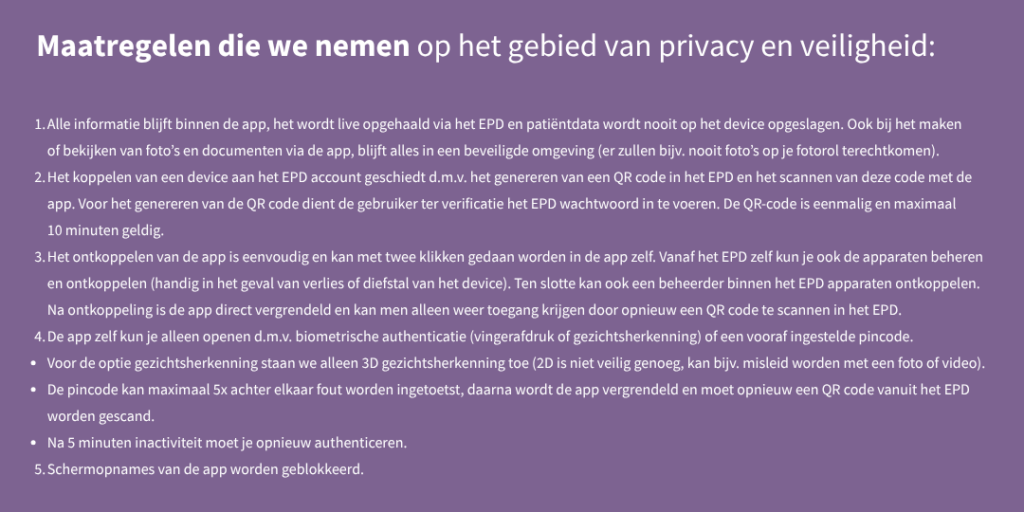
Mobile working entails real risks. Smartphones can, and certainly have, the image of getting lost, unsafe or be unsecured or mix private and business use. Much mental healthcare-Organizations and professionals are therefore rightly hesitant to use private devices for the EHR.-access. Mobile use of client records in mental healthcare is only permitted if security and privacy are guaranteed both technically and in use. This includes risk analyses, managed devices, and a checklist for rollout (and collection).
In addition, practitioners may experience increasing workload due to mobile accessibility. Continuous notifications and client messages can reinforce the feeling of being “always on,” which is at odds with sustainable employability and professional recovery. As a mental healthcare organization, establish clear accessibility rules and triage procedures (including duty rosters, limiting non--urgent notifications and an alternative emergency channel) so that notifications outside working hours are filtered and distributed. As a professional, use a work profile/'do not disturb', process messages at fixed times, communicate your response times, and delegate triage to safeguard recovery and work-life balance.
In addition to information security and workload, physical strain a role. Prolonged work on smartphones or tablets increases the risk of neck-, shoulder- and wrist complaints. Guidelines regarding when mobile working is functional and when it is not are therefore also highly desirable from an ergonomic and sustainable employability perspective.
Why the fixed workplace remains crucial
At the same time, mobile working is not a substitute for the fixed workplace. Particularly in a sector where administrative burdens are already high, there is a real risk that mobile registration will lead to fragmented information, loss of clinical coherence and incomplete financial accountability.
Psychological work requires reflection, hypothesis formation, and the integration of information. Writing treatment plans, diagnostic considerations, ROM-Interpretations and legally relevant reporting proceed better in a fully-fledged workplace with overview, calm, and a complete EHR.-functionality. The fixed workplace therefore remains essential for quality and professional accountability.
From standalone technology to smart work process
Mobile working yields efficiency gains when it is part of a clear work process. A recognizable and effective approach is:
- Mobile: capture brief notes, observations, and client input in real time.
- Permanent: complete extensive reporting, clinical reflection, and decision-making at the office.
This is especially important for psychologists in training, where reporting, supervision, and joint case file discussions are crucial for professional development. This also deserves attention at the team level: individual, mobile recording must not undermine collaboration and multidisciplinary coordination.
Future-oriented: AI as a lever against administrative burden
It is in that context that the true promise of AI lies. Not as a replacement for the professional, but as a tool to reduce administrative burden. Consider:
- automatic summaries of session notes to draft reports;
- spraak-to-text to limit typing and ensure that the file is immediately complete and up-to-date;
- smart signaling in monitoring data;
- decision support for risk signals.
It is essential that AI remains supportive and does not become the guiding principle. The clinical judgment, professional autonomy, and ethical responsibility of the practitioner remain central.
Conclusion: technology must give time back to healthcare
Mobile working and AI are not ends in themselves, but means to address an urgent problem: too much time spent on administration, too little on treatment. Only when organizations explicitly prioritize efficiency, quality, and workability can these tools contribute to more treatment capacity, less burden and better mental health care.
The key lies not in more digitalization, but in Smarter design of safe and user-friendly work processes, with the professional's craftsmanship as the starting point.